
Rice County Criminal Court Records
A criminal court record is the case-level file kept by the court after a complaint or other charging document opens a criminal case. In Rice County, the local trial court is Rice County District Court. It handles criminal cases filed in the county as part of Minnesota's Third Judicial District. Court Administration keeps the court file, calendar, public access terminal path, copy process, and certified copy process.
The criminal court record should be read as a case file, not as proof that every charge ended in conviction. A file may show charges that were amended, dismissed, resolved by plea, resolved at trial, or tied to probation violation events. For the charge side of the arrest-to-court path, use the separate page on Rice County arrest records and court charges. For the full case file and outcome, this criminal court records page is the right focus.
Rice County criminal matters are part of the District Court jurisdiction described by Minn. Stat. section 484.01, which gives District Court original jurisdiction over criminal cases and other proceedings. Appeals from District Court generally move to the Minnesota Court of Appeals unless an exception applies.
Search Rice County Criminal Cases
The online search path is MCRO Case Search. Choose the Criminal case category and Rice as the county court location when narrowing results. Search by case number when possible. Name searches can miss pending criminal, traffic, and petty misdemeanor cases with no conviction, but those matters may return by case number. A 66-CR prefix usually points to a Rice County criminal case.
- Open MCRO Case Search and accept the terms. MCRO states that its records are unofficial.
- Search by case number, citation number, defendant name, business name, attorney name, or attorney license number.
- Use Additional Search Options to select Rice County and narrow by Criminal case category, date filed, date of birth, or status.
- Open Case Details and read the Register of Actions for charges, hearings, pleas, motions, orders, disposition, sentencing, and warrant entries.
- Contact Rice County Court Administration for certified copies or older public records that are not available online.
The statewide court system is not the same as a fingerprint-linked criminal history check. MCRO itself warns users not to rely on name searches for background checks. The Minnesota Bureau of Criminal Apprehension criminal history system is the separate background-check source referenced in the research.
Rice County Criminal Case Stages
A criminal case record grows as the case moves through hearings and orders. The daily calendar research for Rice County showed hearing types such as Arraignment, First Appearance, Plea Hearing, Pre-trial, Omnibus Hearing, Jury Trial, Court Trial, Bail Hearing, Initial Appearance - Rule 8, and Probation Violation Hearing. These words matter because they show where the case is in the court process.
Case flow: Charges Filed › First Appearance or Arraignment › Rule 8 or Omnibus Hearing › Pretrial Motions › Plea or Trial › Disposition › Sentencing.
| Stage | What Happens in the Court Record |
|---|---|
| Charges Filed | The complaint or charge entry starts the criminal case and receives a Rice County case number. |
| First Appearance or Arraignment | The court addresses rights, charges, release conditions, plea entry, or next hearing dates depending on case level. |
| Rule 8 or Omnibus Hearing | The record may show probable-cause issues, pretrial motions, evidence issues, and future settings. |
| Plea or Trial | The court record may show a guilty plea, not-guilty plea, verdict, dismissal, or other outcome. |
| Disposition and Sentencing | The record may list the final outcome, sentence, probation terms, fines, fees, restitution, or jail/prison terms. |
What Rice County Criminal Records Show
Rice County criminal court records can include the complaint, case number, charges, bail or bond notes, hearing entries, pleas, motions, orders, trial entries, disposition, sentence, probation violation records, fines, fees, restitution, and warrants. The Register of Actions is often the easiest way to follow the case. It is a chronological docket that shows case events in sequence.
| Field | What It Shows |
|---|---|
| Case Number | The Rice County criminal identifier, commonly a 66-CR case number. |
| Defendant | The person charged in the District Court case, subject to public-access limits. |
| Charges | Charge description, degree, offense date, and changes when public and available. |
| Hearings | Dates, times, courtrooms, judicial officers, and hearing types such as plea or omnibus hearing. |
| Plea | The defendant's formal answer to a charge, such as guilty or not guilty. |
| Disposition | The outcome of the charge or case, including dismissal, conviction, acquittal, or other result. |
| Sentence | Punishment or conditions imposed after conviction, including probation, fines, restitution, or custody terms. |
| Warrant Events | Warrant issued, warrant quashed, failure to appear, or probation violation entries where public. |
Rice County Criminal Prosecution
Minnesota counties use the term County Attorney rather than District Attorney. The Rice County Attorney's Office is at 218 Third Street NW, Faribault, MN 55021. Rice County Attorney Brian Mortenson leads the office. The main phone is 507-332-6103, and office hours are 8 a.m. to 4:30 p.m. Monday through Friday. The office handles prosecution and other county legal duties, but it does not represent or advise private residents.
The official County Attorney overview says the office is elected and handles child support and paternity enforcement, child and vulnerable adult protection, juvenile prosecution, certain adult criminal prosecution, victim services, county-board representation, civil commitment matters, and legal advice to county departments. For criminal court records, the key point is that the County Attorney's Office files and prosecutes many Rice County criminal matters, while Court Administration keeps the court record.
The manifest assigns the Rice County Attorney's Office source to this criminal court records page.

This office source identifies the county prosecutor channel, but court file copies still come through Court Administration.
The Attorney overview screenshot is also assigned here from the same prosecution context.

The overview helps separate prosecution duties from the court's record-management role.
Charges vs Convictions
A charge is an accusation filed in court. A conviction is a court outcome after a guilty plea, guilty verdict, or other conviction entry. Rice County criminal court records may show charges that never became convictions. They may also show amended, reduced, dismissed, or resolved counts. MCRO warns that case type is not an indicator of final outcome, so the disposition and sentence fields must be read before drawing conclusions.
| Charge | Conviction | |
|---|---|---|
| Meaning | An allegation filed or tracked in a criminal case | A final finding or plea of guilt entered by the court |
| Where It Appears | Complaint, charge list, hearing entries, warrant details, or Register of Actions | Disposition, sentencing, judgment, or final case outcome fields |
| Can Change | May be amended, reduced, dismissed, or replaced | Can be appealed, corrected, or affected by later expungement rules |
| How to Verify | Read each charge and status | Read the disposition and sentence, then request a certified copy if needed |
The official Rice County Prosecution page states that the Criminal Division prosecutes all felonies committed within Rice County and certain misdemeanor or gross misdemeanor matters.

That prosecution source supports the local charging role, while the criminal case outcome remains in the District Court record.
Public Access to Criminal Records
Rice County criminal court records are generally public when no rule, statute, court order, or access limit closes the record. Rule 2 presumes Judicial Branch records are open. Rule 4 identifies inaccessible records. Rule 8 controls remote access, copying, and limits on online display. County law-enforcement reports are different and are governed through the office holding the data under the Minnesota Government Data Practices Act.
Certified criminal copies are not downloaded from MCRO as certified records. For Rice County, certified copies come from Court Administration at 218 Third St. NW, Faribault, MN 55021. The phone number is 507-497-7134, and public hours are Monday through Friday, 8 a.m. to 4:30 p.m. Uncertified copies can be useful for review, but a certified copy is the formal court-authenticated document.
Note: MCRO name searches are not a substitute for fingerprint-linked criminal history checks through the proper state system.
Sealed vs Expunged Records
Sealing and expungement affect public access to criminal court records. Minnesota has petition-based expungement and automatic expungement for some qualifying records. Expungement does not always destroy a record. It commonly seals public access and limits disclosure except where a statute or court order allows access. The practical first step is to identify the exact Rice County case number, then review eligibility and procedure.
| Sealed Record | Expunged Record | |
|---|---|---|
| Public View | Closed from ordinary public inspection by law or court order | Public access is limited under Chapter 609A or court order |
| Record Status | Record still exists but is restricted | Usually sealed from public access, not necessarily destroyed |
| How It Happens | By statute, rule, or court order | By petition or automatic statutory process for qualifying records |
| Starting Point | Confirm case number and restriction type | Confirm case number, agencies involved, and eligibility basis |
The image manifest assigns three Minnesota expungement statute sources to this page. The first is Minn. Stat. section 609A.02, the eligibility statute.
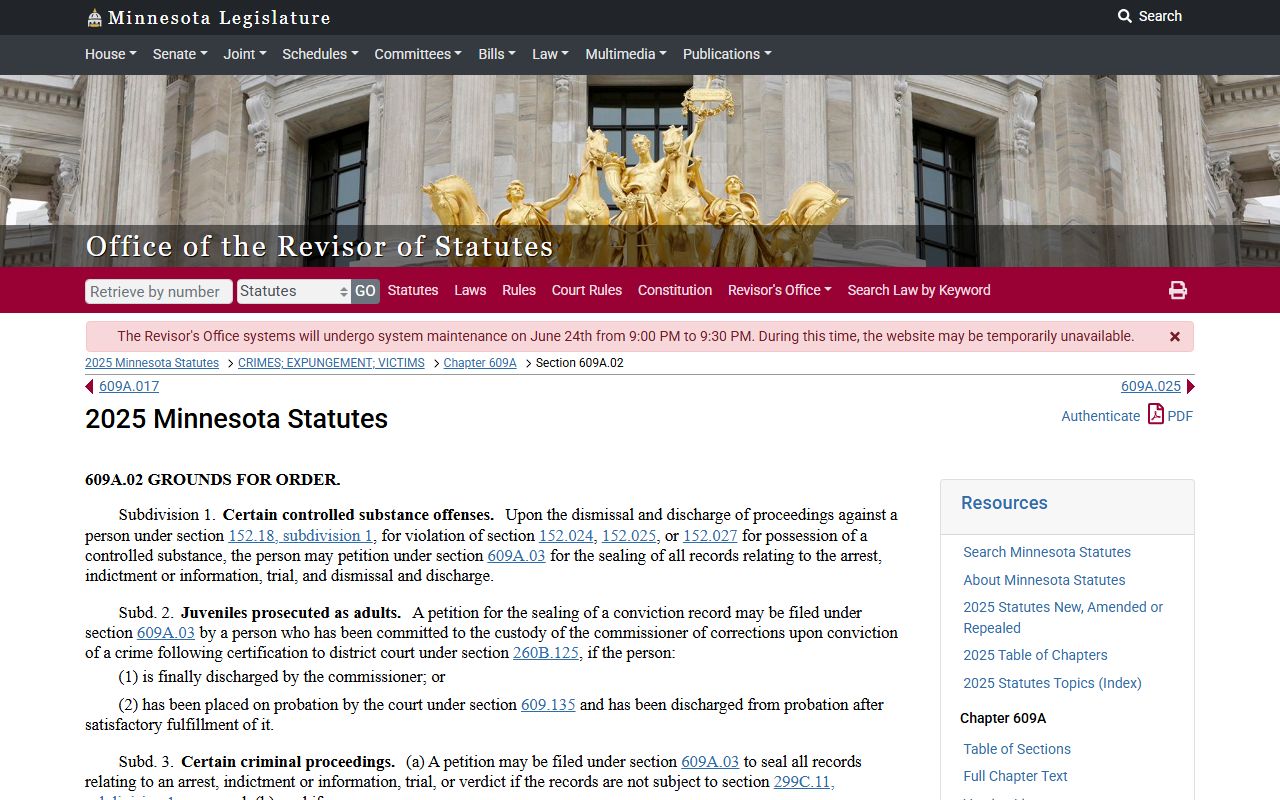
Eligibility rules determine whether a Rice County criminal court record can be considered for expungement.
The second expungement source is Minn. Stat. section 609A.03, which covers petition procedure and filing-fee rules.
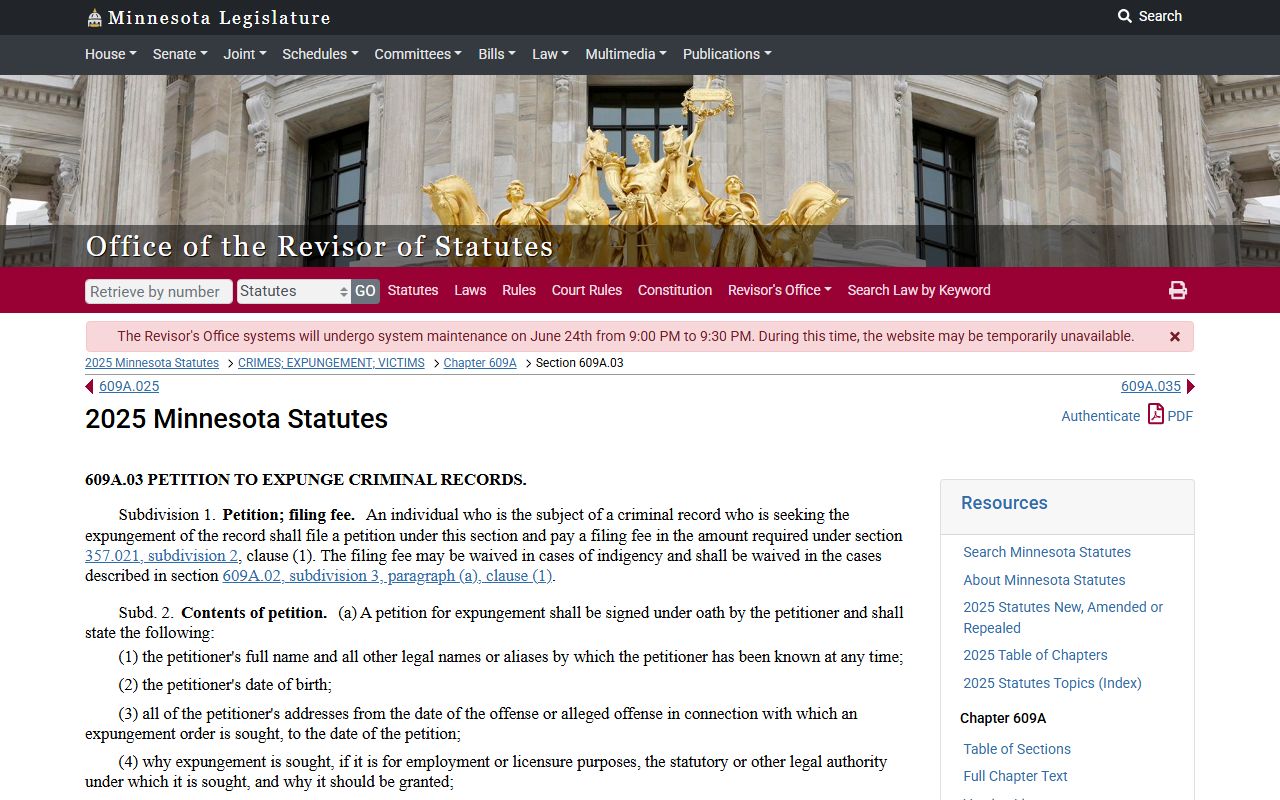
Petition-based expungement can require identifying the case, the agencies holding records, the legal basis, and the reason sealing should be ordered.
The third assigned statute source is Minn. Stat. section 609A.015, the automatic expungement statute.
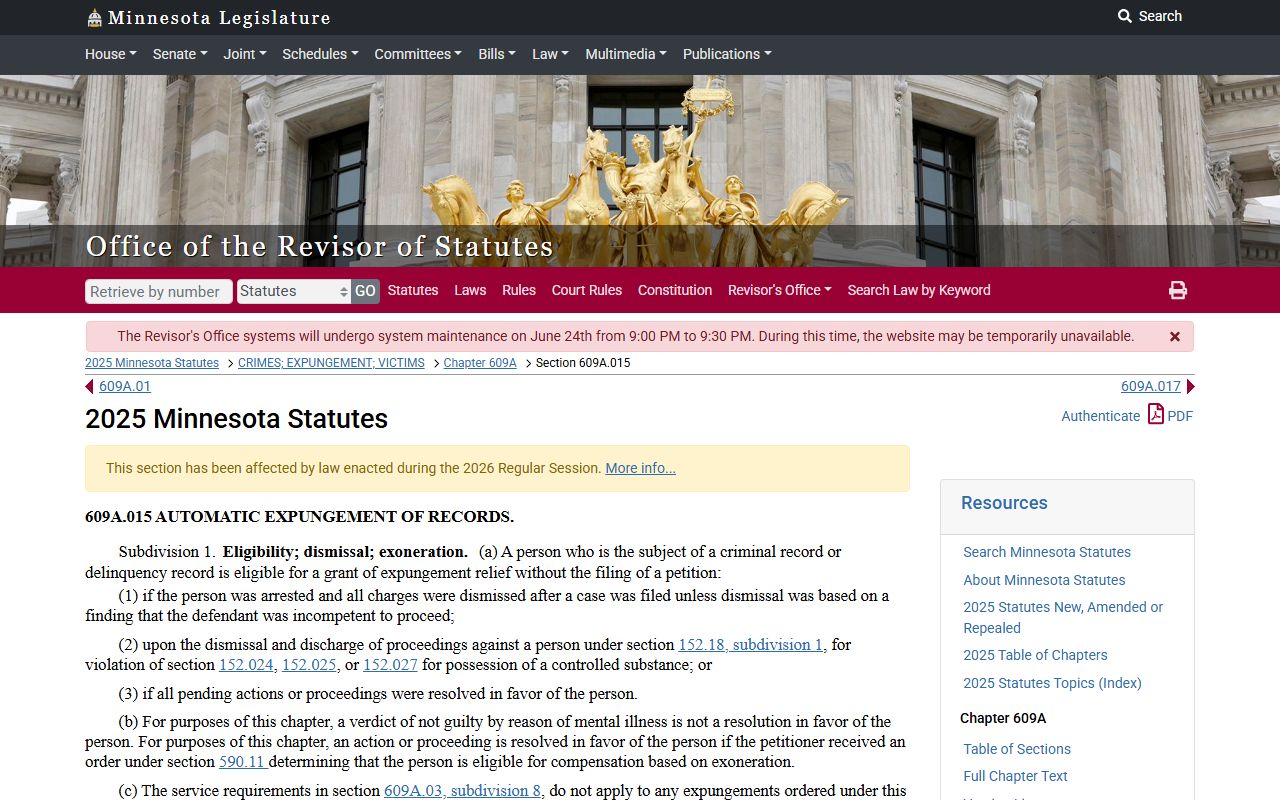
Automatic expungement can apply only when the record qualifies under the statute, so it should not be assumed from a search result alone.
Restricted Rice County Criminal Records
Juvenile cases have more limits than adult criminal cases. MCRO excludes CHIPS and certain juvenile delinquency case types from internet access, and Rule 4 restricts juvenile appeal cases arising from proceedings not open to the public. Civil commitment and medical records have their own limits. Personal identifiers can be removed from remote display under Rule 8, including Social Security numbers, financial account numbers, many street addresses and phone numbers, and identifying information for victims, witnesses, and jurors.
Public Defender contact for qualifying criminal and juvenile delinquency cases is listed at 507-455-5887 through the Third Judicial District Owatonna Office. That office is separate from Court Administration and the County Attorney. The County Attorney prosecutes eligible cases for the state; the public defender may represent qualifying defendants; the court maintains the criminal case record.